Wednesday, June 14, 2006

The Eyes of the Nation are on Troy, NY*

So, in case you hadn’t heard (and I’m guessing you hadn’t), today is that most universally ignored of American holidays, Flag Day! Flag Day is celebrated (such as it is) on June 14th every year, because it was on that date in 1777 that the Second Continental Congress adopted the stars and stripes as the official flag of the…er…whatever exactly we were then (confederated colonies?). This makes June 14th as Flag Day completely logical, unlike some other patriotic holidays I might mention (stay tuned a few weeks from now for my post, “Why July 4 Shouldn’t Be America’s Birthday”).

And in honor of that well-scheduled day (seriously, I was kind of grasping at straws of what to say about Flag Day) I present this article in today’s Washington Post, which I’ve been recommending to everyone, based on its sheer weirdness. Here’s a snippet:

But in our flag there isn't that kind of hierarchy between the zones -- any sense of a lesser "this" grafted on top of a primary "that," or of a smaller "that" superseding an expanse of underlying "this-ness." There's just a feeling of redundant additivity -- a sense of "this-plus-that" which, in purely graphic terms, seems willful and arbitrary.
I mean, that’s just one of the most hilariously incomprehensible passages I’ve ever read. That said, I’m not mocking this article. I’m happy that the Post took a different slant (although it does seem they were as lacking for a Flag Day writing theme as I was), and at times, the article is at least mildly interesting.

What I love most, however, is the very fact that they are comparing the flag to modern art! This is sure to make some wingnut’s head explode. In fact, it’s even better in the print edition than it is on the website. In the print edition, on the front page of the Style section, above the fold, is a huge color picture of a flag with the headline under it, “A Grand Old Flag.” But when you unfold the paper, you see the rest of the headline, “And Very Modern Art.” I like to envision a Republican culture warrior seeing that page, and saying “Outstanding! It’s good that the liberal media can take one day to worship the flag,” and then unfolding the page. “Modern art? What? NOOOOOOOO!!!!!!”

Good times.

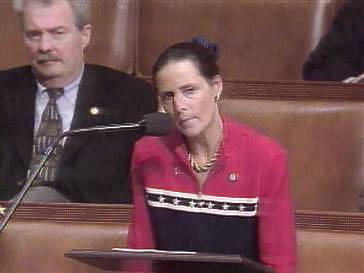
Also, the article says that wearing the American flag is illegal in DC. Apparently the outfit of Rep. Jean Schmidt (R, It’s-Too-Depressing-for-Me-to-Say) below, like the actions of Karl Rove, falls just short of indictability.


No word on whether flag enthusiast Rep. Schmidt
plans to call any veterans cowards today.

Happy Flag Day, everyone.

*Troy, NY, is the site of the nation’s largest Flag Day parade.

Tuesday, June 13, 2006

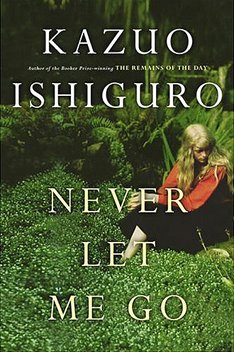
Never Let Me Go, by Kazuo Ishiguro

Either in high school or junior high, one of my English classes was assigned to read John Knowles's A Separate Peace. Set at an elite private boys' school on the eve of World War II, it was maybe a poor curriculum choice for a primarily rural school district in the Upper Midwest. The popularity of Skoal and Brooks & Dunn might have been a signal that James Dickey's Deliverance or anything about the Snopeses would have gone over better. Not for the last time, I adopted the reverse-snobbery of my classmates, who had little interest in a moral novel about friendship between elite prep school kids. I've stayed skeptical of this particular coming-of-age genre.

But that was more than a decade ago, and on Sunday, I spent my day reading Kazuo Ishiguro's Never Let Me Go, another story about the morality of a group of kids at an elite prep school, but one with a chillier heart and big ideas in mind. It's clear from the book's first pages that something is askew. The narrator, Kathy H., is a nurse of unspecified expertise, looking back on her education at a school called Halisham. After vague preliminaries about Kath's unusually long professional tenure, she describes a day from pre-adolescence, in which she and her friend Ruth watch a classmate named Tommy lose his temper in a soccer game.

This is a book about Halisham, and a love story about Kathy, Ruth and Tommy. Ishiguro hints that something is wrong with their world -- from Kathy's vague allusions about undefined carers and donors, and her oddly detached narrative voice. There is plenty of emotional repression, yes, but something larger is at work, and only as the story unfolds does its tragedy incrementally become clearer. A novel about moments that haunt you when you're young expands into bigger themes, about science and love and art and free will.

Some reviewers have described the book as science fiction and others as a cautionary tale, and though I don't think either label gets the job done, they'll do for the sake of allusion. But unlike many reviewers, I don't think of the book as a genre piece, or anything close to pulp. Its views about science are to be taken seriously, but I agree with Michiko Kakutani's description of the book as fundamentally "an oblique and elegiac meditation on mortality and lost innocence: a portrait of adolescence as that hinge moment in life when self-knowledge brings intimations of one's destiny, when the shedding of childhood dreams can lead to disillusionment, rebellion, newfound resolve or an ambivalent acceptance of a preordained fate."

Conservative commentors seem to view the book as a warning against unrestrained science. This is a plausible interpretation, but it didn't occur to me as I read it. Instead, I viewed it as having E.M. Forster's soul in Alduous Huxley's body. In much the way that the mafia setting of The Sopranos crystallizes family conflicts that would otherwise seem routine, the genre undertones of Never Let Me Go permit Ishiguro to shed shopworn adolescent baggage and focus his narrative on what matters.

I don't want to say any more about the plot than that. I came into this book without any background -- no Amazon reviews or professional reviews -- and it's best experienced that way. My lack of preparation allowed me to learn about the characters' world alongside them. If I'd known more, I might have loved this book less. I read all 290 pages in a day, staying up until 3 a.m. to finish, at which point I re-read the first chapter and responded in a way appropriate to a five-year-old who's watching Bambi for the first time: a blubbering baby breakdown.

Time Magazine selected Never Let Me Go as one of the 100 best English-language novels since 1923, which sounds about right. In story, narration, and clarity, the book stands on par with Ian McEwan's Atonement. Between McEwan, Ishiguro and Zadie Smith, the Brits are teaching their American counterparts some knockout lessons in how to write a novel. Why the U.S. hasn't yet produced a young-ish writer in the caliber of Smith and Ishiguro, I'll think about some other time.
Monday, June 12, 2006

Well, I Haven’t Been-to-Prague Been to Prague, But I Know That Thing…

I had started writing something earlier about how I love the World Cup. Now, I feel like a guy whose girlfriend is studying abroad in Europe who gets a letter from her about the really deep and romantic guy she met in, well, Prague.

Czech Republic 3, USA 0.

Still, I do love the World Cup. I love most international athletic competitions (I watched hours of curling back in February), but the World Cup is a bit unique. Flights of lyricism about the beauty of the human soul and the beautiful game are all over the internets, but this isn’t one of them. Quite frankly, I don't much care for soccer (I don't have anything against it, but I don't have anything for it, either). But it doesn't matter because, for me, it isn't even about the soccer.

I like the World Cup because it allows me to do two things that are hardwired into my American consciousness, but which usually are in conflict: engage in guilt-free jingoism and root for the underdog. As a nation, we love the underdog. Many of our cultural myths celebrate the triumph of the underdog through force of will, from Horatio Alger to Hoosiers. But let’s face it, we’re America. Globally speaking, we’re the New York Yankees. We’re bigger, stronger, and richer than any other nation on the planet, and, as such, we can’t be considered the underdog in, really, anything.

Except international soccer.

It’s the sport that the rest of the world cares the most about, and we have no hope of winning without a miracle. Team USA…underdogs. I love everything about it. Except when we lose to the freaking Czechs.

Plus, the World Cup quadrenially gives rise to one of my favorite bar arguments, about who would play for Team USA if, like every other country in the world, the best athletes this nation produced played soccer.

International pageantry, guilt-free jingoism, love of the underdog, and interesting bar argument fodder, all provided every four years by the World Cup. What’s not to love?

And if you don’t think Allen Iverson would have completely redefined the striker position as we know it, you’re out of your mind.

The Thick of It on BBC America

Imagine that David Mamet, Ricky Gervais and John Major meet at a party. They hit it off.

In a burst of creative inspiration fueled by Jack Daniels and honey slides, they sit down and hammer out a succession of scripts for a TV comedy. It is laden with bleeped-out eff bombs, discussions about cleaning piss and being pissed on (literal and metaphorical), misogyny, obscene gestures, and neckties. They sell it to BBC under the title The Thick of It. It is, miraculously, in heavy rotation on BBC America.

The show combines elements the original U.K. version of The Office with Deadwood. The Thick of It centers around the staff of an ambitious, hot-tempered and insecure cabinet minister in British Parliament. He's no caricature or empty suit, just, like all of us, prone to screwing up under pressure. A collection of assholes with British accents attend meetings where they belittle each other and shout. No turf is too petty to defend. There aren't plots so much as extended orchestras of oneupsmanship. The prevailing ethos appears to be that once you've humiliated yourself, the only remedy is humiliating everyone around you. It's occasionally impenetrable, and was made for repeat viewing.

In the most recent episode, the Minister spends days in a fit of insecurity after being told by one of Tony Blair's men that Cherie Blair doesn't like him. Venting to his staff, the dialogue includes the following:
"We didn't click? We were talking about the fucking Euro! How are you supposed to click about the fucking Euro? It's fucking impossible."
"Apparently, the PM's wife didn't like me. Did you know this? ... Two reasons. Cut of my jib and insufficient clicking. So consequently I'm going to be a minor footnote to British political history because I didn't have an engaging enough anecdote about Charlotte Church's puppies."
"Between the snatch and the Euro, there's some sort of happy medium."
Unlike The Office and Office Space, this isn't set in cubicles that house quirky-but-sympathetic workaday drones. It's ferocious -- a hothouse profession of private offices and egos and insecurities, where longstanding hatred barely stays contained and frequently explodes. Hence, I find it relateable.

Blair's top man, shouting, apoplectic in his Scottish accent, over cross-dialogue that I rewound several times:
"Come back in here! Hey! Fuck! Julius! Get the fuck back in here! Please. Please. Let's be civilized. ... There aren't human resources. Let's be civilized. Go over to your fucking pantry. Right. Right. Let's just cool it for one minute. Okay? Cool it. And just fucking. Cool it for one minute. Fuck. Shut up and fucking listen to me. This is an old fucking Georgian door. Do you know how long this has been here? Since the time of Elizabeth I, at least. Now look at that. That does not open. Look at it. Look at it. Try to open it. Come on. Character building. Team building. Put your hand on mine. Try to open the door. It's my fucking door! Open the fucking door!"
The point of this conflict? Trying to bully a consultant into opening a door only for the sake of making him open a door.

Later, a member of the cabinet minister's staff insults that same consultant when he's standing directly in front of him, an attack somehow made better by the third-person pronoun:
"I'd like to nail him to a tree through the head and watch lice slowly crawl over his body eating all of his flesh in a slow and painful death, but that rather bitter anomoly aside, most of the responses to the Warrant Report press conference were pretty positive."
Another great riff:
"Since when, Glen, since when, does the secretary of state for social affairs have to find out from the fucking press that every morning at 8:30 I'm being fisted up to the gall bladder by a bald man?"
You see their thin, pasty skins melt in real time.

The Hon. Hugh Abbot, P.C., does not want to hear
about your mother's piss.

Saturday, June 10, 2006

A day at the races

DSCF1456

I spent a beautiful, windy day out at Belmont Park.

For the fourth year in a row, I was a loser all day long. Enjoy my $100 bucks, NYRA! My first time at the track, I came out ahead $150 on the day. It's been downhill ever since. At one point, my betting tactic devolved into picking horses whose names resembled those of my friends -- like Anew, and Rizzi's Brass Band. If I'd been wagering to win instead of on exactas and trifectas, I probably would have had a good day.

It's also great people watching. I saw fourteen-year-olds with cigars, and with nostalgia, I noticed that the vast majority of people who wear suits at the track appear to be younger than 25. This was a stage where wearing a suit connoted adulthood and sophistication, rather than a warning sign that my soul is in trouble.

DSCF1464

Thursday, June 08, 2006

Another reason to avoid MySpace

As reported in New Scientist:

"I am continually shocked and appalled at the details people voluntarily post online about themselves." So says Jon Callas, chief security officer at PGP, a Silicon Valley-based maker of encryption software. He is far from alone in noticing that fast-growing social networking websites such as MySpace and Friendster are a snoop's dream.

New Scientist has discovered that Pentagon's National Security Agency, which specialises in eavesdropping and code-breaking, is funding research into the mass harvesting of the information that people post about themselves on social networks. And it could harness advances in internet technology - specifically the forthcoming "semantic web" championed by the web standards organisation W3C - to combine data from social networking websites with details such as banking, retail and property records, allowing the NSA to build extensive, all-embracing personal profiles of individuals.

My previous thoughts and paranoia on this issue can be found here.

Policy Corner: Won't Someone Think of the Farmers?!?!

(I promise, “Policy Corner” will only appear once in a while)

I am speaking today of that favorite bogeyman of the right, the estate tax.

The Senate Republicans are going to take time out of their busy gay-hating schedule Wednesday and Thursday to try to make permanent the 2001 phase-out of the estate tax, which, they will tell us, is about the most evil thing this side of, well, gay marriage. The Magic Diagnostician himself wrote an article about this on Monday, in which he lays out most of the GOP talking points, all of which run the gamut from “misleading” to “blatant lies.” In the interest of keeping this post to a manageable length, I’ll just focus on the worst, most misleading, most often repeated one:

“But Ann Bennett of Kingsport, Tenn., is a good representative of people who pay the tax.

Her family has farmed the same piece of land for nearly 130 years and already has paid over $100,000 in death taxes so that her father could acquire it from her grandfather. When her father passes on, she and her sisters will have to come up with $2 million or her family will have to sell.”

Ah yes, all the poor family farmers whose legacy is ripped away from them by the evil death tax! It’s an effective technique, casting the government in the role of Hazzard County Commissioner Jefferson Davis Hogg, trying to take the family farm away from one Jesse Duke, and deny his niece and nephews their rightful inheritance.

But it’s just not true. I hate getting in the way of a fine Republican talking point with, you know, “facts,” but this is a lie. Last year (when the bill passed the House), the Congressional Budget Office actually figured out how many family farms would have to have been sold in 2004 if the Democratic plan to reform the estate tax were in effect.

13.

Yes, thirteen.

But, wait, I thought Bill Frist said that the family farmer he mentioned, Ann Bennett, was a “good representative of people who pay the tax.” About 2.4 million people died in the United States in 2004, and THIRTEEN were family farmers whose heirs had to sell part of the farm to pay the tax (that’s five ten thousandths of one percent, for those keeping track at home).

And for this we’re forgoing $1 trillion over the first ten years of repeal?

Out of curiosity, though, I also decided to see what I could find about this Ann Bennett. It turns out that she is quite the activist. In 1999, she turned up installing a Ten Commandments plaque in her local county courthouse. Then she turned up again in 2005, railing against the “homosexual movement.” And you thought “Republicans Hate Gay People Week” was over!

It sure is good to know that the Republicans are fighting hard to secure her inheritance so she can work tirelessly against the “homosexual movement!” Oh, and they’re fighting for these two, as well…

Soccer is Janet Jackson's boob

ABC and ESPN are overrun by the horrible ads -- the ones with U2 music and an Irishman's voice (that can't be Bono) talking about how soccer has saved the world.

At least two blogs that I really like are writing about it. More soon, probably. Then it will be people at work, and Air America, and there will be no escape.

I've made my feelings about this activity quite clear, but I still wasn't prepared for the deluge. The sport's undertones of nationalism and globalist pomposity don't help.

As the poet Alan Thicke once wrote, diff'rent strokes to move the world. But like NASCAR and heroin, I'm content to have soccer enjoyed outside of my presence. We might have soccer to thank for the fact that Europe hasn't had a continental war in 60 years. No small feat, and I'm happy to leave it at that.

And then there's this business about Disney's media empire needing to manufacture a U.S. television market for this sport, and how they're going about it. But that's a more serious conversation for another time. I expect to bitch again before this tournament ends.

The lesson I've learned from this is why some people went apeshit over Janet Jackson's boob. Boob-haters only wanted to watch the Superbowl; I just want to watch PTI. Plenty of people didn't hate Janet Jackson's boob until they were forced to see it; I wouldn't be so annoyed with soccer if U2 music and the Irish narrator (it can't be Bono) weren't in my face.

Boob-haters worried about the future -- more boobs on TV, culminating with halftime shows featuring Janet Jackson's vagina.

I worry that if soccer in this country catches on, I'll have to stomach this garbage for the rest of my life. Already, I'm turning on U2. Hair gel and shiny jerseys? No thank you.

Boob today, goal tomorrow.

Wednesday, June 07, 2006

Jason Grimsley Is Still In the League?

I may have had a different reaction than most people to today’s story about Jason Grimsley’s steroid use. Sure, it’s weird that Jason Grimsley (Jason Grimsley!) has become the Elia Kazan of the steroid era, but unlike Mark McGwire, I did not come here to talk about the present, I came to talk about the past.

Because, you see, this isn’t the first time that Jason Grimsley (at left, presumably before he got on the juice) has come up when the subject is cheating.

Back in 1994, my own beloved Cleveland Indians were in the midst of their first good season in my lifetime. They had a powerful team, a beautiful, brand new stadium that had just opened, and they were challenging the Chicago White Sox for the division title. Of course, then the strike happened, but all that was a month away on July 15, 1994.

On that day, the Indians were playing the rival White Sox at Comiskey Park, and Sox manager Gene Lamont complained that Indians star Albert Belle’s bat was corked. The umpires confiscated Belle’s bat, intending to inspect it after the game. In the interim, the bat was placed in the umpire’s locker. In a ridiculously clumsy attempt to get Belle off the hook, the Indians dispatched a player to crawl through a small crawl space in the ceiling above the umpires locker room, and replace the bat with a cork-free model (this failed miserably, as the bat he replaced Belle’s with clearly had first baseman Paul Sorrento’s name written on it).

The player who wriggled through the ceiling?

Jason Grimsley, the Zelig of baseball perfidy.

Tuesday, June 06, 2006

A typical day/ is described in these haikus./ A boring premise?

When I screeched last night
I was not upset or mad.
Just aimed for surprise.

Why the hangover?
Is it nicotine or beer?
Clean living, someday.

That punch left a bruise.
I know it wasn't meant to.
Actions speak louder.

Spilled juice on my shirt.
Dropped coffee on my trousers.
It's my standard look.

Large-hipped women seen:
Subway staircase. Angles shift.
Thighs encased in jeans.

Flourescent-light frowns.
Blue button-downs. High-heel clops.
Coffee breath abounds.

Playing on iPod:
"Welcome to the Terrordome."
Bounce at work, door closed.

Inane discussion.
Quietly, I nod, knowing.
They think something else.

Waitress who hates all
Glares at me when asked for beer.
Like that tiny tip?